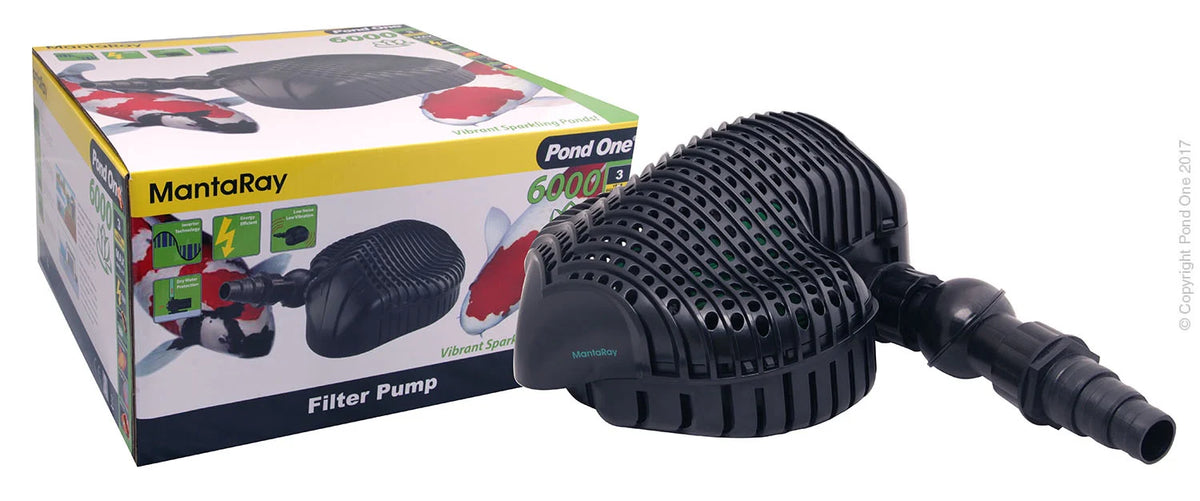
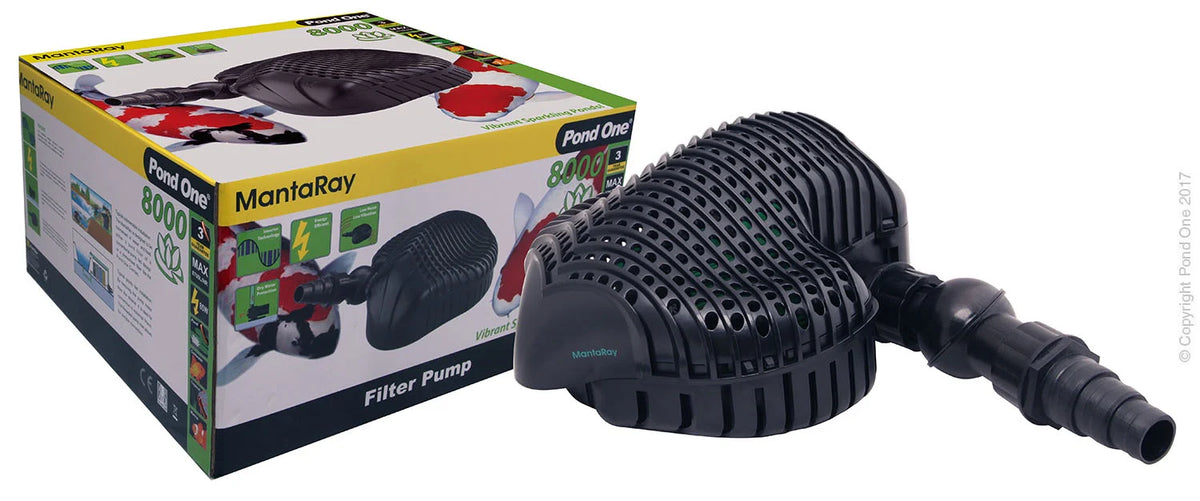
Pond One MantaRay Filter Pump
The Pond One MantaRay Filter Pump is a high-flow pond pump designed primarily for moving large volumes of water through pond filtration systems, waterfalls and larger circulation setups.
Unlike a small fountain pump, the MantaRay is built around high-volume water movement, making it a strong option for larger garden ponds and fish ponds where filtration performance is the priority.
Simply Fish stocks four models:
-
MantaRay 4000 – 4,000L/hr
-
MantaRay 6000 – 6,400L/hr
-
MantaRay 8000 – 8,700L/hr
-
MantaRay 16000 – 16,000L/hr
Pond One also uses a solid-particle handling impeller, low-maintenance intake strainer, multi-directional outlet and built-in pump protection across the range.
Why Choose a MantaRay?
We'd look at a MantaRay when you need:
-
High pond circulation
-
Strong flow through a pond filter
-
Water movement for larger ponds
-
Waterfall circulation
-
Better debris handling than a small fountain pump
-
A pump designed for continuous filtration use
-
Higher head-height capability
-
Replaceable impeller assemblies
-
A low-maintenance intake design
For a small decorative fountain, the Pond One Pondmaster MK II may make more sense.
For a proper filtration system moving several thousand litres per hour, the MantaRay is where we'd start looking.
Which MantaRay Size Do I Need?
MantaRay 4000
Maximum Flow: 4,000L/hr
Maximum Head: 3.2m
Power Consumption: 30W
Best suited to:
This is the smallest MantaRay and a good entry point when you want a dedicated filter pump without moving into extremely high flow.
MantaRay 6000
Maximum Flow: 6,400L/hr
Maximum Head: 3.3m
Power Consumption: 50W
Best suited to:
A useful middle-ground pump for ponds where 4,000L/hr won't provide enough real-world flow after plumbing losses.
MantaRay 8000
Maximum Flow: 8,700L/hr
Maximum Head: 4.5m
Power Consumption: 85W
Best suited to:
The additional head capability makes this particularly useful where water has to travel uphill before reaching the filter or waterfall.
MantaRay 16000
Maximum Flow: 16,000L/hr
Maximum Head: 6.5m
Power Consumption: 180W
Best suited to:
This is a serious pond pump and should be matched carefully to the filter and plumbing rather than simply chosen because it has the biggest number.
Pond One's published specifications confirm these flow, head-height and power figures.
MantaRay Size Guide
| Model |
Maximum Flow |
Maximum Head |
Power |
| MantaRay 4000 |
4,000L/hr |
3.2m |
30W |
| MantaRay 6000 |
6,400L/hr |
3.3m |
50W |
| MantaRay 8000 |
8,700L/hr |
4.5m |
85W |
| MantaRay 16000 |
16,000L/hr |
6.5m |
180W |
Remember: Maximum Flow Is Not Your Actual Flow
This is probably the most important thing to understand.
A MantaRay 8000 is rated at up to 8,700L/hr.
That does not mean you'll necessarily get 8,700L/hr coming out of the end of the hose once you've connected:
Pump flow decreases as resistance and head height increase.
Pond One's own performance curves show flow progressively dropping as head height increases across all four MantaRay models.
So give yourself some headroom when sizing the pump.
Match the Pump to Your Filter
If you're running a Pond One ClariTec, don't simply choose the largest MantaRay available.
The filter has its own maximum flow rate.
For example:
-
ClariTec 3000 → maximum 3,000L/hr
-
ClariTec 5000 → maximum 5,000L/hr
-
ClariTec 10000 → maximum 10,000L/hr
-
ClariTec 15000 → maximum 15,000L/hr
Your goal is for the actual delivered flow to suit the filter once plumbing losses are taken into account.
Too little flow can mean weak circulation.
Too much flow can exceed what the filter is designed to handle.
Pump and filter sizing should be treated as one decision.
MantaRay vs Pondmaster MK II
These ranges overlap slightly, but we'd generally think of them differently.
Choose a Pondmaster MK II if:
-
You want a fountain
-
You have a smaller pond
-
You want general circulation
-
Your required flow is relatively modest
-
You're powering a smaller waterfall or water feature
Choose a MantaRay if:
-
Filtration is the priority
-
You need several thousand litres per hour
-
You have a larger pond
-
You're running a substantial waterfall
-
You need better debris handling
-
You need higher head capability
For a small decorative pond, we'd usually save the money and use a Pondmaster.
For a larger Goldfish pond running a substantial filter, we'd be much more likely to look at the MantaRay.
Built for Pond Filtration
One of the most useful features of the MantaRay is its solid-particle handling impeller.
Ponds aren't clean environments.
The pump may encounter:
-
Leaves
-
Small plant material
-
Fish waste
-
Fine sludge
-
Organic debris
The MantaRay is designed around this type of pond filtration work rather than expecting perfectly clean water entering the pump. Pond One also uses a surrounding strainer housing with raised leaf guards intended to reduce intake blockage.
That doesn't mean you should deliberately bury it in sludge.
But it is better suited to dirty pond-water filtration duties than many smaller general-purpose pumps.
Low-Maintenance Intake Strainer
The MantaRay's outer housing acts as a large intake strainer.
Pond One specifically designed the raised openings to make it harder for leaves to sit flat against the housing and block water flow.
That helps:
You should still check and clean the pump periodically.
No pond pump is genuinely maintenance-free.
Multi-Directional Outlet
The MantaRay uses a ball-joint-style adjustable outlet.
This lets you direct the hose in different directions rather than forcing the plumbing into an awkward bend immediately after leaving the pump. Pond One says this design is intended to reduce unnecessary frictional resistance.
That's useful because every unnecessary restriction in your plumbing costs you flow.
Use the Largest Practical Hose
Don't spend hundreds of dollars on a powerful pond pump and then choke it with tiny hose.
Undersized hose creates extra resistance and reduces the flow you actually get.
Where your pump, filter and installation allow it, we'd generally use a suitably large hose and keep the plumbing:
A clean plumbing layout can make a surprisingly large difference.
What Does Head Height Mean?
Head height is essentially how hard the pump needs to work to lift water vertically.
If your pump is at pond level and the filter inlet is 1.5 metres higher, you've already introduced roughly 1.5m of static head before considering hose resistance.
The MantaRay models have maximum head ratings ranging from 3.2m to 6.5m.
But remember:
Maximum head does not mean useful full flow at that height.
At maximum head, flow is approaching zero.
Choose your pump according to the flow you require at your actual operating height.
Example: Running a ClariTec
Say you're running a filter that ideally wants around 5,000L/hr of actual flow.
Your filter sits about 1 metre above pond level and you have several metres of hose.
A pump rated at exactly 5,000L/hr at zero head may no longer provide anything close to 5,000L/hr by the time water reaches the filter.
That's where something like the MantaRay 6000 may make more sense than choosing a smaller pump that only just meets the theoretical requirement.
The actual choice will depend on the full plumbing layout.
Example: Waterfall
Suppose you're trying to run a substantial waterfall.
You need to consider:
A pump might technically get water to the top but still produce a disappointing trickle once all those losses are factored in.
For waterfalls, we'd generally rather have some excess capacity than discover after installation that the pump is too small.
Built-In Pump Protection
Pond One equips the MantaRay with protection against dry-running conditions and electrical overload to reduce the chance of pump damage.
That's a very useful safeguard.
But don't interpret it as permission to deliberately run the pump dry.
The manufacturer's information still says the pump should normally operate submerged unless it is correctly installed as an inline pump in an appropriate filtration system.
Submerged or Inline Use
The MantaRay is designed primarily as a pond filter pump and can be used submerged.
Pond One also allows inline operation when installed correctly within an appropriate filtration setup.
For most normal garden pond installations, submerged operation will be the simplest approach.
How Do I Install It?
A typical setup looks like:
Pond → MantaRay → Pond Filter → Return to Pond
or:
Pond → MantaRay → Filter / UV → Waterfall → Pond
Basic installation:
-
Work out your pond volume.
-
Choose your filter.
-
Check the filter's required flow.
-
Calculate your approximate head height.
-
Choose the appropriate MantaRay.
-
Position the pump securely.
-
Attach appropriately sized hose.
-
Keep plumbing as direct as practical.
-
Connect the filter.
-
Start the pump.
-
Check all fittings for leaks.
-
Confirm that your actual water flow is suitable.
Where Should I Position the Pump?
Don't simply drop it into the deepest pile of sludge in the pond.
We'd position it where:
-
Water can reach the intake freely
-
It isn't constantly buried in sediment
-
You can retrieve it for maintenance
-
The plumbing route is practical
-
Good pond circulation is created
In some setups, positioning the pump away from the filter return can also help encourage water movement across the pond.
Maintenance
If flow begins to reduce, check the pump before immediately assuming it has failed.
Look at:
-
Outer intake strainer
-
Leaves
-
String algae
-
Impeller
-
Hose
-
Filter
-
Plumbing restrictions
The MantaRay housing is designed to be dismantled with minimal tool use, and the impeller assembly can be removed for cleaning.
Replacement Impellers Are Available
One thing we particularly like about this range is that replacement impeller assemblies are available.
Pond One lists:
Simply Fish already carries these replacement parts.
That's useful on a more expensive pump because a worn impeller doesn't necessarily mean throwing the entire unit away.
Energy Consumption
Despite their high flow rates, the four models use:
-
4000 – 30W
-
6000 – 50W
-
8000 – 85W
-
16000 – 180W
according to Pond One's current technical sheet.
Because pond filtration pumps may run continuously for long periods, electrical consumption is worth considering when comparing models.
Don't massively oversize the pump without a reason.
Three-Year Guarantee
Pond One backs the MantaRay range with a 3-year guarantee.
Follow the manufacturer's installation and maintenance requirements to keep the pump operating correctly.
Simply Fish Recommends
The MantaRay is where we'd look when someone says:
“I don't care about a little fountain — I need to move a serious amount of water through my pond filter.”
The biggest mistake is still the same one we see with every pump:
Sizing it based purely on the zero-head flow number.
If your filter needs 6,000L/hr and you buy a pump rated at exactly 6,000L/hr, but you've then got:
-
1.5m of vertical lift
-
6m of hose
-
Several bends
-
A UV
-
A filter
you're probably not going to get the flow you expected.
Give yourself enough pump capacity to account for the real installation.
But don't go completely the other way and connect a 16,000L/hr pump to a filter rated for 5,000L/hr.
The pump, filter and plumbing all need to match.
If you're unsure, give us:
and we'll help work out which MantaRay makes sense.
Specifications
MantaRay 4000
Maximum Flow: 4,000L/hr
Maximum Head: 3.2m
Power: 30W
Voltage: 220–240V
Pond One Code: 93007
MantaRay 6000
Maximum Flow: 6,400L/hr
Maximum Head: 3.3m
Power: 50W
Voltage: 220–240V
Pond One Code: 93008
MantaRay 8000
Maximum Flow: 8,700L/hr
Maximum Head: 4.5m
Power: 85W
Voltage: 220–240V
Pond One Code: 93009
MantaRay 16000
Maximum Flow: 16,000L/hr
Maximum Head: 6.5m
Power: 180W
Voltage: 220–240V
Pond One Code: 93010
FAQ
What is the Pond One MantaRay designed for?
Primarily high-volume pond filtration, circulation and waterfalls.
What sizes are available?
Simply Fish stocks the MantaRay 4000, 6000, 8000 and 16000.
What is the maximum flow?
Depending on the model, maximum flow ranges from 4,000L/hr to 16,000L/hr.
Will I actually get the advertised flow rate?
Not necessarily. Actual flow depends on head height, hose length, hose diameter, bends, filters and other restrictions.
Can I use a MantaRay with a ClariTec filter?
Yes, provided the actual pump flow is appropriate for the selected ClariTec model.
MantaRay or Pondmaster?
We'd generally choose Pondmaster for smaller ponds, fountains and moderate circulation. MantaRay is better suited to higher-flow filtration and larger systems.
Can I run a waterfall with it?
Yes. The MantaRay's higher flow and head capability make it particularly suitable for waterfalls.
Can it handle dirty pond water?
It uses a solid-particle handling impeller and large intake strainer designed for pond filtration duties.
Does it have dry-run protection?
Yes, Pond One lists built-in protection against dry-running conditions and overload.
Can I deliberately run it dry?
No. Follow Pond One's operating instructions. It should normally operate submerged unless correctly installed for inline use.
Can the impeller be replaced?
Yes. Replacement impeller assemblies are available for all four sizes.
How often should I clean it?
As required. Reduced water flow is a good reason to inspect the intake, impeller and plumbing.
Why has my MantaRay lost flow?
Check the intake strainer, leaves, algae, impeller, hose and filter before assuming the motor has failed.
Does it come with a warranty?
Pond One lists a three-year guarantee for the MantaRay range.
Check out our spring pond care blog post for some helpful tips to get your pond ready for the warmer season!